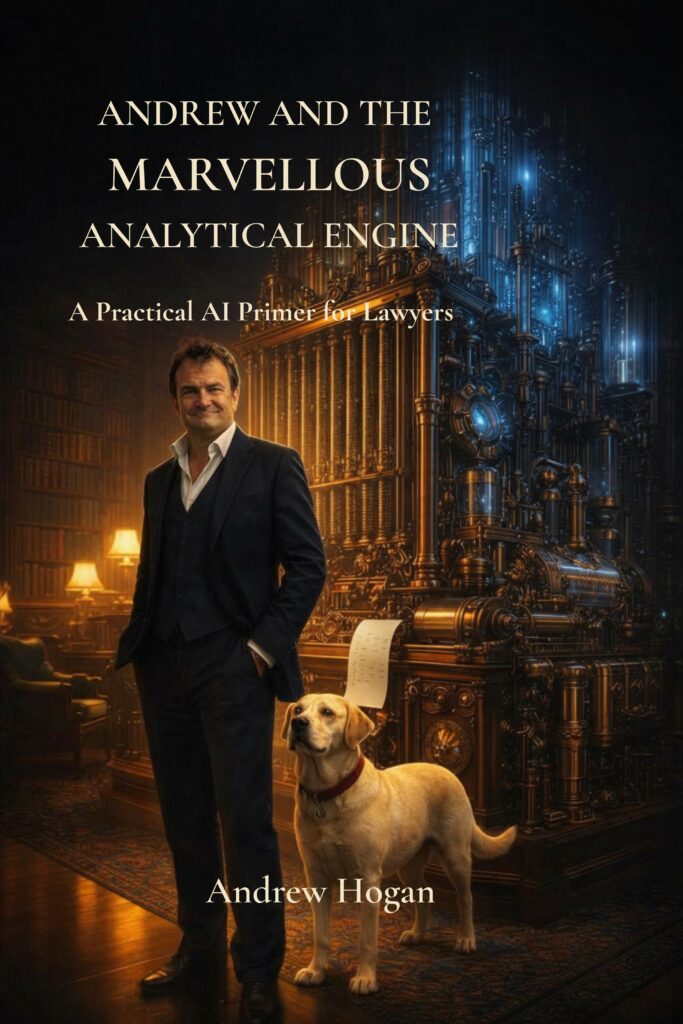
SECOND EDITION
Andrew and the Marvellous Analytical Engine
A Practical AI Primer for Lawyers
Artificial intelligence is no longer an exotic curiosity which lawyers can safely leave to computer scientists and particularly excitable people on LinkedIn. It has become part of ordinary professional life: useful, powerful, occasionally astonishing and still perfectly capable of producing confident nonsense.
The substantially revised second edition is written for lawyers who want to understand enough about the machinery to use it intelligently without acquiring a second career in computer science. It considers what AI is, what it can do in legal practice, where it fails, and why professional judgment still matters.
“A thoughtful and informative guide to AI that will no doubt prove an invaluable handbook for all lawyers — not just those in the middle-aged bracket.”
Law Society Gazette · Five Stars
“An intelligent book about artificial intelligence & lawyers.”
Civil Litigation Brief
Reviews are of the first edition.
WHY A SECOND EDITION?
AI changed. The book had to change with it.
The first edition appeared only a year ago. That ought to have bought it a respectable period of repose on the shelf. Artificial intelligence had other ideas. The technology improved, the legal profession began using it in more serious ways, courts and regulators had more to say about the consequences, and some of the material which had seemed current began to look like archaeology before it had left the printer.
The second edition is therefore not a light revision. It has been substantially rebuilt around the questions a practising lawyer now needs to answer: what these systems can actually do, how they can be used in real legal work, how their output should be checked, and where human judgment and responsibility must remain in control.
FROM BABBAGE TO THE MODERN BAR
The machinery is new. The ambition is not.

The book begins long before ChatGPT. It traces the old human ambition to build machines which calculate, organise information and extend our intellectual reach, from early mechanisms and Charles Babbage through to modern large language models. The history matters because it strips away some of the incense. Artificial intelligence did not arrive from nowhere, nor does every new capability require us to pretend that the machine has become a person.
The practical question is simpler: what work can now be done differently, and what does a lawyer need to understand in order to use the new machinery well?
USING AI IN ACTUAL LEGAL WORK
Research, drafting, litigation and the work around the work.

The practical chapters deal with the jobs lawyers actually do: research, drafting and review, building chronologies, analysing evidence, organising litigation, working with specialist legal platforms and agentic systems, managing information and using AI in practice management, education and business development.
The point is not to turn legal practice into a technology demonstration. It is to identify where AI removes mechanical labour, where it genuinely improves the work, where it merely creates more material to check, and where it should be kept away from the task altogether.
THE LAWYER WHO REMAINS
The interesting question is not what the machine can do. It is what the professional is for.
As routine mechanics become cheaper, the value of judgment, strategy, persuasion, client understanding, responsibility and trust becomes easier to see. The book’s position is neither that AI will replace lawyers nor that professional life can continue untouched. The useful future lies between those two comfortable extremes.
AN ILLUSTRATED BOOK ABOUT MACHINERY
Not every legal technology book contains a Labrador in a flying machine.
The second edition is illustrated throughout with a sequence of fantastical plates in which Sunny and I make our way through libraries, workshops, courtrooms, engines and occasionally the sky. The images are not there to make the subject less serious. They are there because a book about analytical engines need not itself resemble a server rack.
The result is intended to be read as a proper book rather than consulted as an appliance manual: practical where it needs to be, sceptical where the claims become extravagant, and sufficiently eccentric to remember that technology is ultimately made for people.

About Andrew Hogan
I am a practising barrister, called in 1996, with nearly thirty years in civil litigation and a specialist practice in legal costs and litigation funding. The book approaches AI from that professional standpoint: not as an evangelist for technology and not as somebody hoping it will go away.
CHOOSE YOUR EDITION